Hiya! A thousand ways to say hi and more.
Here's a few things you can do here.
- Tap to hear it. Highlighted words play out loud in a native voice.
- Zoom in close. Hold ⌘ or Ctrl and scroll. Pinch works on a trackpad or phone.
- Scan the QR. This allows you to use the poster on your phone.
- Get it on paper. The whole sheet prints 24 × 36 inches. Print your own or Buy the poster.
Cool, why'd you make this?
I made this because every day I chat with people all over the world, and sometimes I need to say a quick Thanks! or Geen dank!
So I wanted to print out a huge cheatsheet I could use to help me commit it all to memory.
Something like this feels more and more useful, in a world where more and more services bring people of different languages together through translation that happens on the fly. YouTube, Instagram and TikTok all translate automatically now, and people expect to be met in their own language.
I've also made it a project to translate all of my sites into every major language, this one included — so you can buy the print in 22 of them. Try the flag at the top right to switch.
Wait, I can buy it in English?!
Yes! You can buy it in most languages now, as either a dark print or a light one. Having this on the wall is a lot of fun — you can buy it here, and there's a QR link at the top, so you can point your phone at it and then tap any word to hear it said.
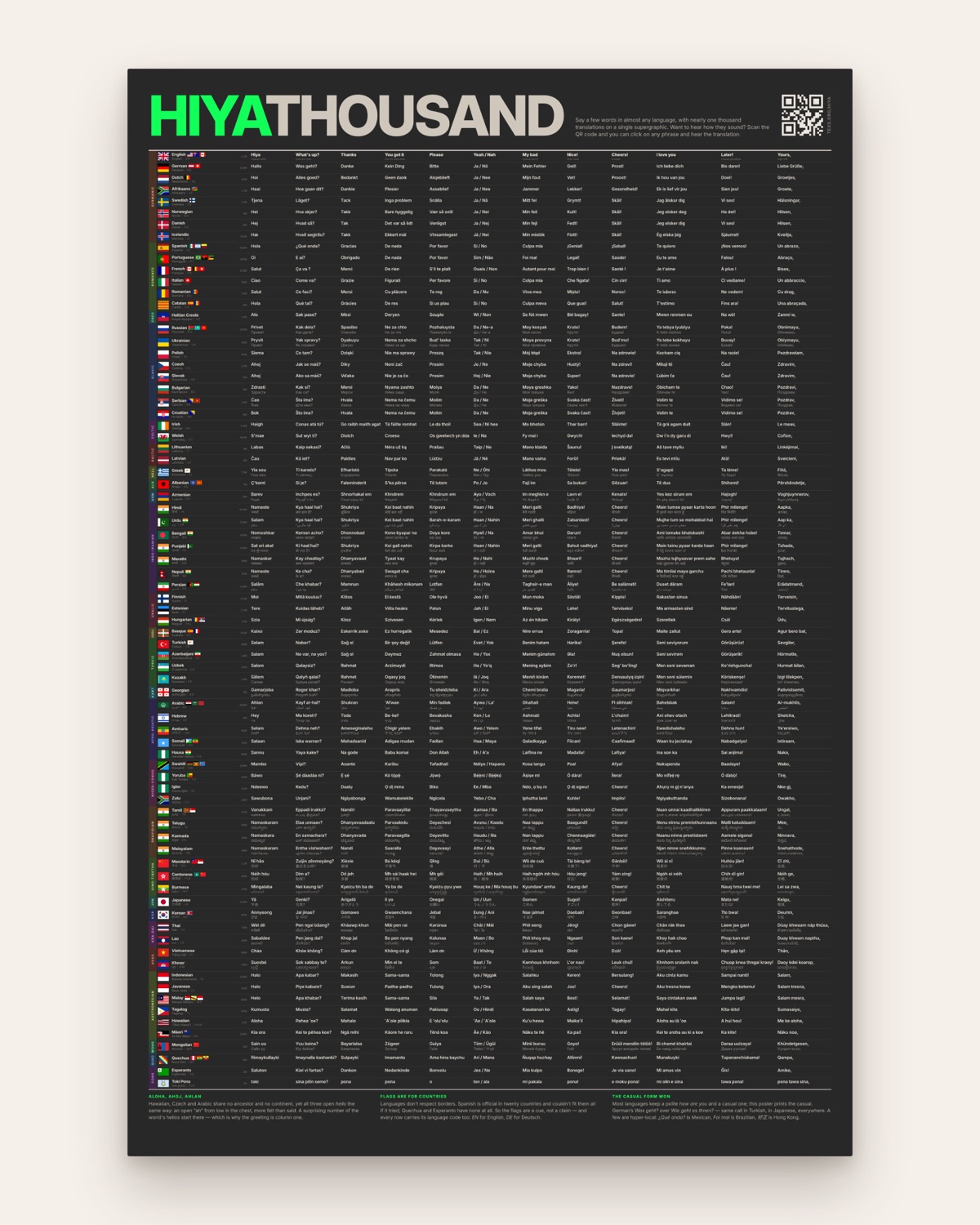
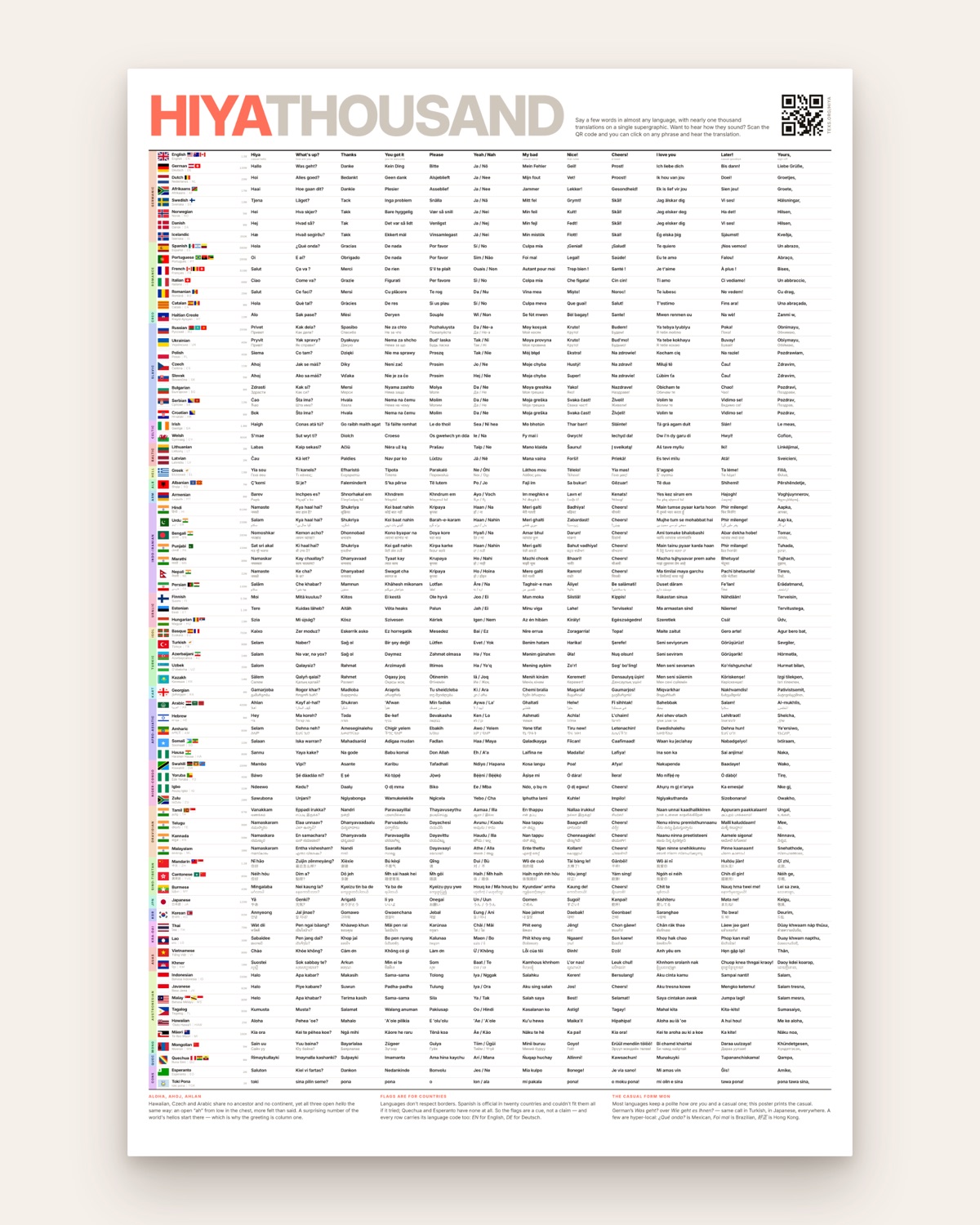
And if you buy the English one, it puts English in the first row. The poster exists in 22 editions, dark or light: English, Spanish, Brazilian and European Portuguese, French, Italian, German, Dutch, Polish, Czech, Croatian, Romanian, Russian, Ukrainian, Turkish, Chinese, Japanese, Korean, Hindi, Arabic, Hebrew and Indonesian.
Each is the whole sheet in that language, down to the name in the masthead — the Spanish one is called HOLAMIL, the German one HALLOTAUSEND.
Why are the phrases so casual?
Most languages keep a polite how are you and a casual one, and every column here prints the casual. German gets Was geht?, not Wie geht es Ihnen? Same call in Turkish, in Japanese, everywhere the split comes up.
78 languages, grouped by family
The rows are ordered by language family, with the family name running up the gutter beside them — Germanic, Romance, Slavic, Indo-Iranian, Sino-Tibetan, Niger-Congo, Austronesian and twenty more, 26 in all. Grouping by family rather than by speaker count is what makes the sheet worth standing in front of: put Hindi beside Persian and the shared words start surfacing on their own.
Tap any phrase and hear it
There is a recording behind all 936 cells: a native voice saying that phrase in that language. On screen you click it. On paper you scan the QR code in the top corner, which opens this same sheet on your phone, and then you point at the wall and tap.
Getting one on the wall
It prints 24 × 36 inches on 170gsm coated silk, made to order at whichever press is nearest to you and posted from there, so it travels a short way rather than a long one. Shipping is free. If you would rather print it yourself, Print / PDF in the toolbar gives you the same sheet at the same size.